
Red Light, Green Light
A bee, a ladybug and a snail race across the stage — but only while the referee says they may. This is the playground game, and it is also the first project where sprites send each other messages.
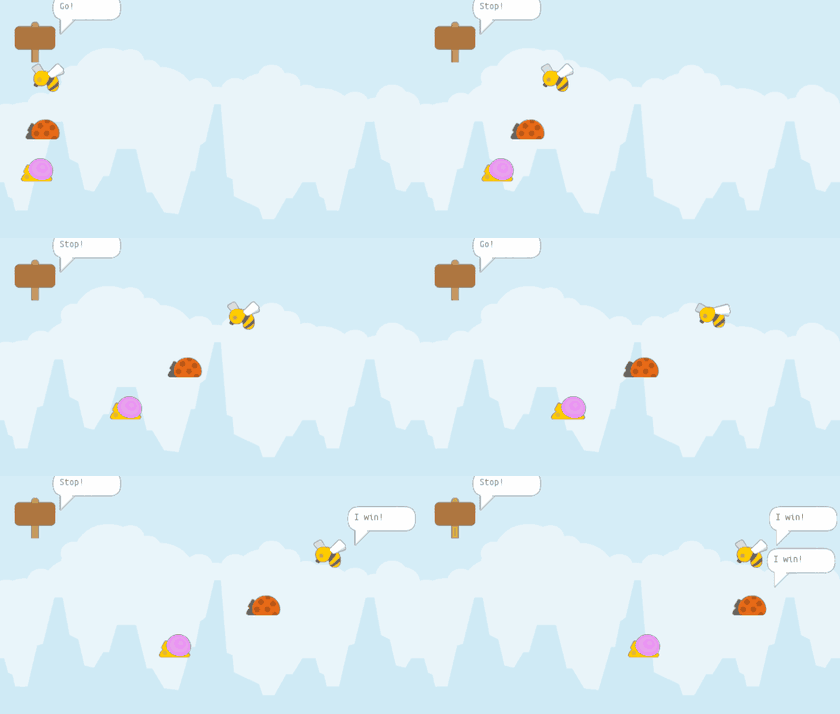
Nothing here needs a downloaded file.
The problem messages solve
The referee has to start and stop three racers. You could give the referee a list of every racer and call a method on each one. That works until you add a fourth racer, and then you have to remember to add it to the list too.
Messages turn it around. The referee shouts and does not care who is listening:
broadcast [go v]
Any sprite that wants to can listen:
when I receive [go v]
Add a fourth racer and it starts listening on its own. The referee never changes.
Step 1: The referee
The referee flips between stop and go every couple of seconds and announces it.
broadcast sends the message to every sprite on the stage.
import org.openpatch.scratch.*;
public class Referee extends Sprite {
private boolean green = false;
public Referee() {
this.addCostume("sign");
this.setSize(45);
this.setPosition(-250, 110);
}
public void run() {
if (this.getTimer().everyMillis(2200)) {
this.green = !this.green;
if (this.green) {
this.say("Go!");
this.broadcast("go");
} else {
this.say("Stop!");
this.broadcast("stop");
}
}
}
}
this.green = !this.green flips a true into a false and back again. It is a
tidy way of saying "switch to the other one".
Step 2: A racer that listens
whenIReceive is called on every sprite whenever anybody broadcasts. The message
arrives as text, so the racer checks which one it was.
import org.openpatch.scratch.*;
public class Racer extends Sprite {
private String creature;
private double speed;
private boolean running = false;
public Racer(String creature, double y, double speed) {
this.creature = creature;
this.speed = speed;
this.addCostume(creature);
this.addCostume(creature + "_move");
this.setSize(45);
this.setPosition(-260, y);
}
public void whenIReceive(String message) {
if (message.equals("go")) {
this.running = true;
}
if (message.equals("stop")) {
this.running = false;
this.switchCostume(this.creature);
}
}
public void run() {
if (!this.running) {
return;
}
this.changeX(this.speed);
if (this.getTimer().everyMillis(150)) {
this.nextCostume();
}
if (this.getX() > 170) {
this.say("I win!");
this.running = false;
}
}
}
Text is compared with equals, not with ==. message == "go" asks whether
they are the same piece of text in memory, which is not what you mean.
message.equals("go") asks whether they say the same thing, which is.
The racer never mentions the referee, and the referee never mentions the racer. Neither knows the other exists.
Step 3: One class, three racers
Look at the constructor: Racer(String creature, double y, double speed). Until
now your sprites have been made with new Something() and nothing else. Giving
the constructor parameters means one class can produce three different
racers.
import org.openpatch.scratch.*;
public class RaceStage extends Stage {
public RaceStage() {
super(600, 340);
this.addBackdrop("background");
this.add(new Referee());
this.add(new Racer("bee", 60, 2.2));
this.add(new Racer("ladybug", 0, 1.6));
this.add(new Racer("snail", -60, 1.0));
}
public static void main(String[] args) {
new RaceStage();
}
}
The costume name is a parameter too, and because every creature in the built-in
library has a matching _move costume, creature + "_move" gives the racer its
second picture without you naming it twice.
Here is the whole race. Nobody has to touch the keyboard for this one — watch the sign, and add a fourth racer to see that the referee really does not care:
In Scratch this would have been three separate sprites, each with its own copy of the same scripts, and a change to one meaning three edits.
The finished project
If something will not run, you can compare against the finished version. It needs no assets, only the library itself.
Project: Red Light, Green Light 100%Things to try
A fourth racer
Add a fourth racer. frog and fishGreen both have _move costumes.
Hint
Racer already works for any creature. All you need is one more line in the
stage.
Solution
In the constructor of RaceStage:
this.add(new Racer("frog", -120, 1.3));Notice that the referee needs no change at all. It broadcasts to everyone who listens, however many that are.
Back to the start
Press R to send everyone back to the start.
Hint
The referee can broadcast a third message, "reset", from whenKeyPressed. The
racers already listen in whenIReceive. They need one more if.
Solution
In Referee:
public void whenKeyPressed(KeyCode key) {
if (key == KeyCode.R) {
this.broadcast("reset");
}
}In Racer:
public void whenIReceive(String message) {
if (message.equals("go")) {
this.running = true;
}
if (message.equals("stop")) {
this.running = false;
this.switchCostume(this.creature);
}
if (message.equals("reset")) {
this.running = false;
this.switchCostume(this.creature);
this.setX(-260);
}
}Unpredictable
Make the referee wait a random time instead of always 2.2 seconds, so the stop cannot be predicted.
Hint
Keep the waiting time in a field instead of writing 2200. Every
time the light changes, pick a new random time with Random.randomInt.
Solution
import org.openpatch.scratch.*;
public class Referee extends Sprite {
private boolean green = false;
private int delay = 2200;
public Referee() {
this.addCostume("sign");
this.setSize(45);
this.setPosition(-250, 110);
}
public void run() {
if (this.getTimer().everyMillis(this.delay)) {
this.green = !this.green;
this.delay = Random.randomInt(800, 3000);
if (this.green) {
this.say("Go!");
this.broadcast("go");
} else {
this.say("Stop!");
this.broadcast("stop");
}
}
}
}